

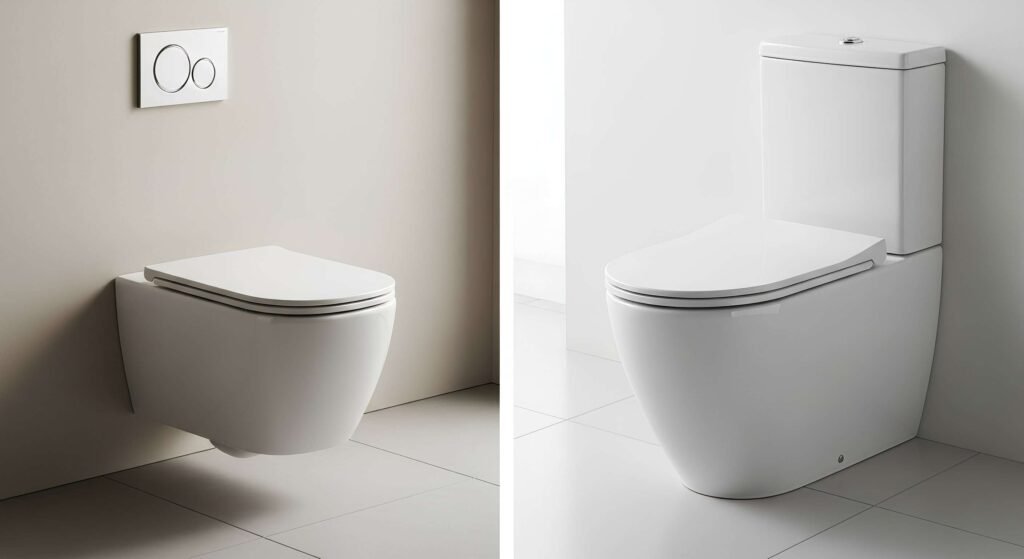
Choosing between wall-hung vs floor-mounted commodes in Bangladesh is not simply a style decision. The right option depends on your drainage position, available space, wall or floor construction, installation budget, maintenance access and the exact commode model you choose.
This practical Harrington guide compares both formats so homeowners, architects and project teams can make a more informed decision before finalising plumbing or buying sanitary ware.
Wall-hung vs floor-mounted commodes: quick comparison
| Comparison | Wall-hung commode | Floor-mounted commode |
|---|---|---|
| Mounting | Bowl mounted to a compatible support system | Bowl sits on the finished floor |
| Cistern | Usually concealed behind a wall or service enclosure | Usually visible on one-piece or close-coupled designs |
| Floor cleaning | Floor remains open beneath the bowl | Cleaning is around the base of the commode |
| Planning | Needs frame, cistern, enclosure depth and service-access planning | Often simpler when replacing an existing floor-mounted toilet |
| Installed cost | Can include bowl, frame, cistern, flush plate and wall finishing | Usually fewer concealed components |
| Best decision factor | Complete installed layout | Plumbing compatibility and total projection |
What is a wall-hung commode?
A wall-hung commode has a bowl suspended above the floor. The cistern is normally concealed inside a compatible support frame behind a finished wall or enclosure. This creates a visually lighter bathroom and keeps the floor beneath the bowl accessible.
However, the concealed frame and cistern still occupy space. When comparing a wall-hung commode for a small bathroom, measure the finished enclosure depth plus the bowl projection, not the ceramic bowl alone.
Browse the Harrington wall-hung commode collection and see our wall-hung commode price in Bangladesh guide for complete-system planning.
What is a floor-mounted commode?
A floor-mounted commode rests directly on the finished floor. A one-piece commode combines the bowl and visible cistern in one ceramic body, while other floor-mounted designs may use separate components.
For renovation projects, a compatible floor-mounted model can sometimes reduce alteration work when the existing waste outlet and water connection already suit the new product. Always confirm the exact trap type and rough-in from the model drawing.
Explore Harrington one-piece commodes and our one-piece commode price guide.
Which option is easier to clean?
A wall-hung bowl leaves the floor below accessible, which can simplify floor cleaning. A floor-mounted commode can also be easy to maintain when its external ceramic body is smooth and the installation leaves sensible access around it.
Do not choose on appearance alone. Check the bowl geometry, rim design, seat hinges, external surfaces and the manufacturer’s cleaning instructions for the exact model.
Which saves more space?
Wall-hung commodes often look more spacious because the floor remains visible, but visual openness and actual installed depth are different. The support frame, concealed cistern and finished wall thickness must be included in your plan.
For a floor-mounted commode, compare total projection from the finished wall and door clearance. In compact apartments, a well-proportioned floor-mounted model can sometimes fit more efficiently than a poorly planned concealed system.
Installation and service access
A wall-hung installation should be planned before the wall is closed. The installer needs to confirm the frame, fixing method, cistern, flush plate, waste position, finished seat height and service access. Many systems allow routine valve maintenance through the flush-plate opening, but not every possible repair can be assumed to happen through that opening.
A floor-mounted commode generally keeps more components visible, but compatibility with the waste connection remains critical. Mounting style does not automatically determine trap type, flushing performance or water use.
How to compare the complete cost
- Wall-hung: bowl, seat, concealed cistern, support frame, flush plate, connectors, wall enclosure, finishing and labour.
- Floor-mounted: commode, seat, internal fittings, connectors, delivery, labour and any plumbing alterations.
Always compare quotations with the same scope. A cheaper bowl can become the more expensive installation if extensive plumbing or wall changes are required.
Which commode is better for your Bangladesh home?
Choose a wall-hung commode when you value a cleaner visual line, accessible floor area and are able to plan the concealed system correctly. Choose a floor-mounted or one-piece commode when compatibility with existing plumbing, straightforward replacement and visible service access are higher priorities.
The most reliable decision comes from the installation drawing, not from a generic label. Bring your bathroom dimensions, outlet position and photos of the existing plumbing when discussing a model.
Frequently asked questions
Is a wall-hung commode always more expensive?
Not necessarily at product level, but the complete system may include a frame, concealed cistern, flush plate, enclosure and additional finishing work. Compare installed cost rather than bowl price alone.
Can I replace a floor-mounted commode with a wall-hung model?
Sometimes, but it is normally a renovation project rather than a direct swap. The installer must assess the waste connection, support structure, frame depth and service access.
Which is best for a small bathroom?
Measure the complete installed projection of both options. A wall-hung bowl can create visual openness, but the concealed system still requires depth.
Contact Harrington with your measurements to discuss suitable commode options for your home or project.